Snake Plant Care: The Complete Beginner’s Guide
Snake plants are famously tough — but they’re not indestructible. Learn the right light, how rarely to water, the best soil, and how to fix soft, wrinkled or falling leaves.
In this guide
Quick answer
Give your snake plant medium to bright indirect light (it tolerates low light), water only when the soil is completely or almost completely dry — often every 2–4 weeks, less in winter — and plant it in a fast-draining cactus or succulent mix in a pot with a drainage hole. Overwatering is the main thing that kills snake plants.
Snake plant at a glance
- Botanical name
- Dracaena trifasciata (formerly Sansevieria trifasciata)
- Light
- Low to bright indirect; some direct sun once adjusted
- Water
- When soil is dry most of the way down
- Soil
- Gritty cactus / succulent mix
- Temperature
- Warm room temperatures; keep above about 50°F (10°C)
- Humidity
- Average home humidity is fine
- Difficulty
- Very easy
- Pets
- Toxic to cats and dogs (ASPCA)
Snake plants are one of the best houseplants for beginners. Their stiff, upright leaves store water, so they shrug off missed waterings, dry air and less-than-perfect light. Most snake plant problems come from giving them too much attention — especially too much water.
Light
Snake plants are famous for tolerating low light, but tolerating isn’t the same as thriving. In a dim corner they’ll survive and stay mostly the same size for years. In medium to bright indirect light — near an east or west window, or a few feet from a south window — they grow faster, stay sturdier and may even produce new pups (offshoots).
They can handle some direct sun if you introduce it gradually. A sudden move from a dark room to a hot windowsill can scorch the leaves.
Not sure what your light is like? Read how much light indoor plants need.
Watering
Water a snake plant when the soil is dry almost all the way to the bottom of the pot. Push a wooden skewer or your finger deep into the soil to check.
- Spring and summer: often every 2–3 weeks, depending on light and pot size.
- Autumn and winter: sometimes only once a month or less.
When you water, soak the soil until water runs out of the drainage hole, then let it drain completely. Never leave the pot sitting in water. Avoid pouring water into the center of the leaf rosette, where it can sit and cause rot.
The #1 snake plant killer
Soft, mushy, yellowing leaves that fall over are almost always a sign of too much water and root rot. When in doubt, wait another week. Our guide to overwatered vs underwatered plants explains how to rescue it.
Soil and pot
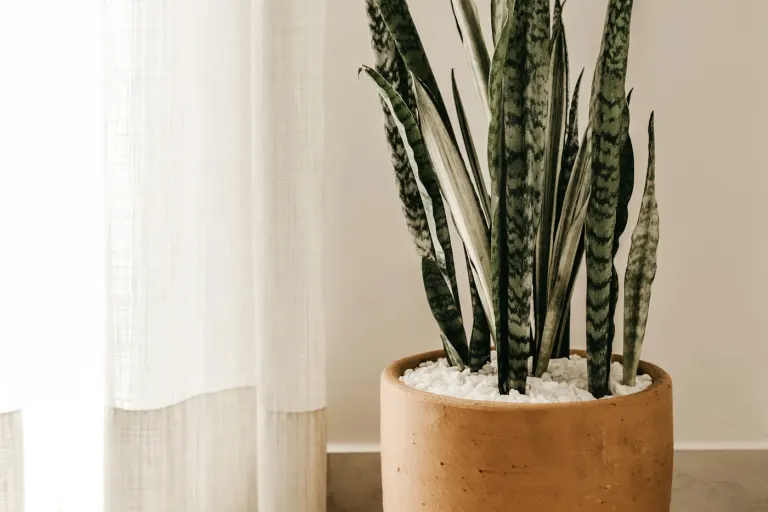
Use a fast-draining cactus or succulent mix, or blend regular potting mix with plenty of perlite or pumice. Terracotta pots are a great match because they help soil dry out. A heavy pot also keeps tall plants from tipping.
See our potting mix guide for simple recipes.
Temperature and humidity
Normal room temperatures suit snake plants well. Keep them away from cold drafts and don’t let them sit near glass that gets very cold in winter — prolonged cold can damage the leaves. Average household humidity is perfectly fine; there’s no need to mist.
Fertilizer
Snake plants are light feeders. Feed with a balanced houseplant fertilizer at half strength once or twice during spring and summer. Skip it entirely in autumn and winter.
Repotting
Snake plants like to be a little snug and usually only need repotting every two to three years, or when roots crowd the pot, crack a plastic container or push the plant up and out of the soil. Move up just one pot size, in spring if possible. Our repotting guide walks you through it.
How to propagate a snake plant
- Division (best): when repotting, separate a pup or section with its own roots and pot it separately. It keeps the exact leaf pattern of the parent.
- Leaf cuttings: cut a healthy leaf into sections a few inches long, let the cut ends dry for a day or two, then set them upright (right way up) in moist, gritty mix or in water. Roots can take weeks to months. Note that leaf cuttings of varieties with yellow edges usually grow back without the yellow edge.
Learn more in houseplant propagation for beginners.
Common snake plant problems
| Problem | Likely cause | What to do |
|---|---|---|
| Soft, mushy or yellow leaves | Overwatering / root rot | Stop watering; check roots; repot in gritty mix |
| Wrinkled, thin or curling leaves | Thirst (or roots too damaged to take up water) | Water thoroughly if soil is dry; check roots if soil is wet |
| Leaves falling over or bending | Overwatering, low light or damage at the base | Let soil dry; move to brighter light; support or remove bent leaves |
| Brown, crispy tips | Very dry soil for too long, or old damage | Water a little more consistently; trim tips |
| No new growth | Low light or winter rest | Brighter spot; be patient until spring |
| Pale or bleached patches | Sudden strong sun | Filter light; move gradually |
For more, see why leaves turn yellow and brown leaf tips.
Are snake plants safe for pets?
No. The ASPCA lists snake plants as toxic to cats and dogs. Chewing the leaves can cause stomach upset such as vomiting and diarrhea. Keep them out of reach of pets and small children, and see our list of pet-safe indoor plants for alternatives.
A note on air purification
Snake plants often appear on “air-purifying plant” lists. While plants make a room feel fresher and more pleasant, a normal number of houseplants isn’t a substitute for good ventilation or an air purifier. Grow snake plants because they’re beautiful and easy — not as an air-cleaning device.
Frequently asked questions
Can a snake plant live in a room with no windows?
Not without help. It can survive for a while under bright office lighting, but in a windowless room it needs a grow light on a timer to stay healthy long term.
How big do snake plants get?
It depends on the variety. Common types reach 2–4 feet tall indoors over several years, while compact “bird’s nest” types stay under a foot.
Do snake plants flower?
Occasionally, especially mature plants that are a bit root-bound and get good light. The flowers grow on a tall stalk, are pale and can be sweetly scented, often at night.
Should I cut off a damaged snake plant leaf?
Yes. Cut badly damaged or mushy leaves off at the soil line with a clean knife. You can trim just a brown tip, but the cut edge won’t grow back.
Sources and further reading
- ASPCA — Toxic and Non-Toxic Plants
- University of Missouri Extension — Caring for Houseplants